
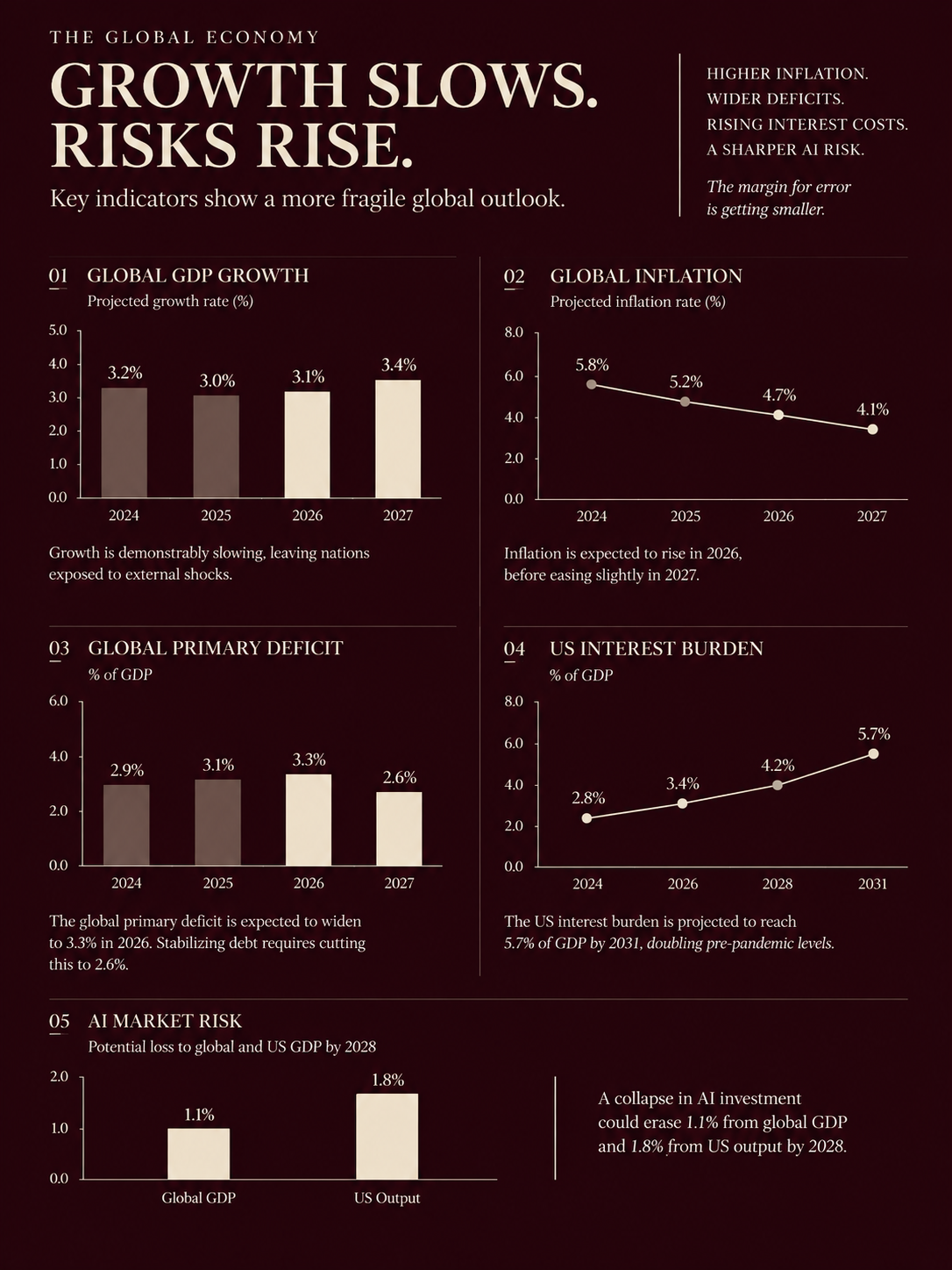
The Era of Narrowing Buffers The International Monetary Fund’s World Economic Outlook, released in October 2026, paints a precarious picture of the global economy. While acknowledging that markets have demonstrated remarkable resilience through recent geopolitical and energetic shocks, the IMF has adopted a highly cautious tone, noting that this resilience is becoming uneven. The central thesis of the report is that the financial buffers that protected nations from consecutive crises are now rapidly narrowing. Global economic growth is officially projected to slow down to 3.1 percent in 2026, before experiencing a minor rebound to 3.4 percent in 2027. In this high-stakes environment, the margin for error has essentially evaporated, keeping risks to the outlook tilted heavily to the downside.
The US Fiscal Deficit Red Flag At the center of the IMF’s urgent warnings is the fiscal policy of the United States. High and rising debt is intensifying the interaction between fiscal policy and interest rates globally. The IMF notes that the global primary deficit, which excludes interest payments, is expected to widen and reach about 3.3 percent of GDP in 2026. Stabilizing the global debt-to-GDP ratio this year would require aggressively cutting that figure down to around 2.6 percent. In the United States, the situation is particularly acute; interest payments are projected to climb from about 2.8 percent of GDP before the pandemic to a staggering 5.7 percent in 2031, which is roughly equal to projected expenditures on Social Security, the nation's largest single entitlement program. Globally, the effective average interest cost of government financing is projected to rise from 2.3 percent in 2021 to 3.7 percent by 2031. The IMF stresses that running such massive deficits forces governments to issue unprecedented levels of debt, and rising interest bills are becoming an increasingly inflexible burden on public resources.
The Unprecedented AI Borrowing Risk Perhaps the most novel and pressing threat identified in the October 2026 assessment is the intersection of artificial intelligence and sovereign debt. The IMF highlights growing debt levels and a potential end to the AI boom as significant risks to the economic outlook. Trade in AI goods grew by an astonishing 29 percent between 2023 and 2025, which is more than triple the 8.3 percent growth rate of overall global trade during the same period. Without this AI trade, overall growth in global trade would have been a mere 4.6 percent. However, this heavy reliance creates vulnerability. The IMF warns that declining expectations for returns on AI investment could undermine the economic outlook. A steep drop in AI investment could cut global GDP by 1.1 percent by 2028, and trigger a severe 1.8 percent decline in United States output.




Comments