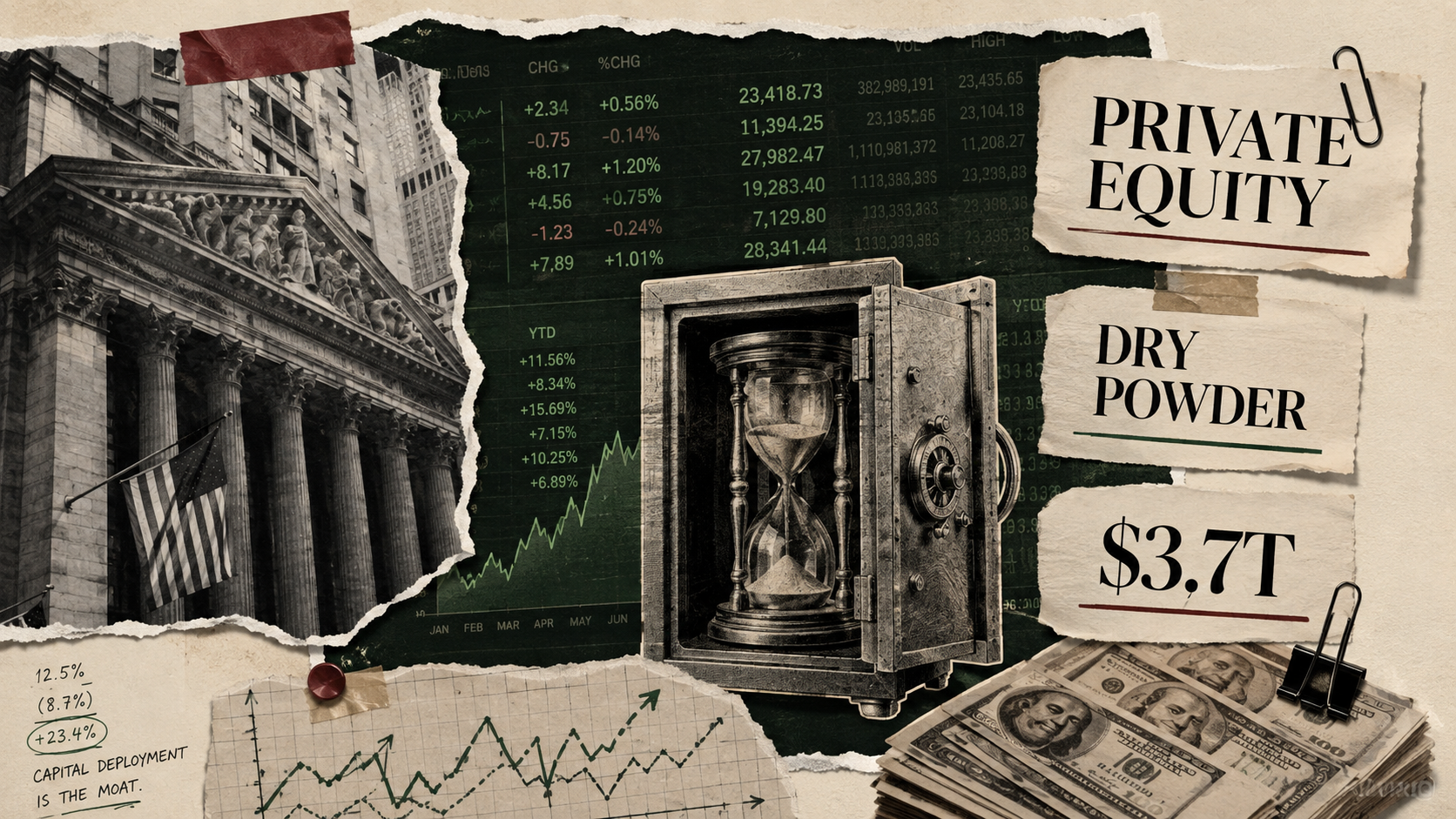
Private equity entered 2026 with a problem it has never faced at this scale. Across the industry, managers are sitting on roughly $3.7 trillion of committed but undeployed capital, a figure that has roughly doubled over the past five years. The money is promised, the funds are raised, and yet a record share of it remains parked, waiting for deals that managers are reluctant to close at current prices.
Dry powder is supposed to be a sign of strength. It means limited partners have handed their capital to general partners who they trust to put it to work. When the pile grows this large and sits this long, though, it stops reading as firepower and starts reading as a backlog. The 2022 to 2024 fundraising vintages are now approaching the deadlines that matter, because most buyout funds operate on investment periods of around five years. Capital raised in that window has to be deployed soon or returned, and neither option is comfortable in a market where sellers and buyers still disagree on value.
Why the capital is stuck
The root cause is the exit environment. Since 2022, the pace of exits has slowed sharply, and that slowdown is the central challenge facing the asset class. Interest rate increases eroded the valuations that underpinned the deals of the prior cycle, and an uncertain macro outlook pushed managers to hold portfolio companies longer rather than sell into a soft market. The largest deals show the strain most clearly. In the mega-deal segment above $500 million, investments fell by around a fifth while exits collapsed by closer to half, a gap that tells you how many managers are simply choosing to wait.
That choice has a cost. Every quarter a portfolio company stays unsold, the clock on the fund keeps running, fees keep accruing, and the capital that should have recycled back to LPs stays locked inside the position. The dry powder problem and the exit problem are the same problem viewed from two ends. Managers cannot return capital because they cannot exit, and they hesitate to deploy new capital because they cannot yet point to strong realisations from the last fund.
The pressure on LPs
For limited partners, the imbalance shows up as a distribution drought. Allocators committed capital expecting a rhythm of calls and returns. Instead, calls have continued while distributions have thinned, leaving many institutions overcommitted to private markets on paper and short of the realised cash they planned to recycle into new funds. Pension plans, endowments and family offices that model their private programmes around steady distributions have had to adjust, slowing the pace of fresh commitments until existing capital comes back.
This is where the feedback loop tightens. Some LPs now treat a manager's large unspent balance as a reason to hold off on the next fund, on the logic that there is no point adding to a pile that is not being deployed. That reluctance feeds straight back into fundraising, which has stayed slow precisely because the exit engine that funds new commitments has been running cold. The slow pace of exits is the primary drag on fundraising across both private equity and venture, and dry powder is the visible residue of that drag.
What managers are doing about it
The better firms are not waiting passively. Continuation vehicles, in which a manager moves an asset from an ageing fund into a new structure backed by fresh and existing investors, have become a standard tool for returning some capital while holding quality assets longer. Net asset value lending lets managers borrow against a portfolio to fund distributions without forcing a sale at the wrong price. Dividend recapitalisations serve a similar purpose. None of these are exits in the traditional sense, and each carries its own risks, but together they reflect an industry improvising its way through a clogged exit channel.
On the deployment side, the middle market has become the relief valve. Mega deals depend on debt markets and strategic buyers that have been cautious, while smaller transactions can still be sourced, priced and financed with less friction. A meaningful share of the capital that does get deployed in 2026 is expected to flow into mid-market opportunities, where managers can act without waiting for the largest deals to thaw.
What it means for capital
The dry powder overhang is not a crisis, but it is a discipline test. Funds that deploy well into a quieter market, when competition for assets is lower and entry prices are more reasonable, have historically posted some of the strongest vintages. The danger is the opposite behaviour: deploying capital simply because the clock demands it, chasing deals to avoid returning money, and accepting prices that do not clear the return hurdle. Pressure to put money to work is exactly the condition under which discipline erodes.
For allocators, the signal is to look past headline dry powder figures and ask sharper questions. How long has a manager's capital been committed and unspent? What is the realistic path to exit for the existing portfolio? Is the manager returning capital through genuine realisations or through financial engineering that defers the reckoning? The funds worth backing in this environment are the ones that can show both the patience to wait for the right deals and the realisations to prove they can actually return cash.
The reshaping under way is structural, not cyclical noise. A record pile of committed capital, a frozen exit market, and a distribution drought have combined to change how managers raise, deploy and return money. The firms that come out ahead will be the ones that treat dry powder as a responsibility rather than a trophy.